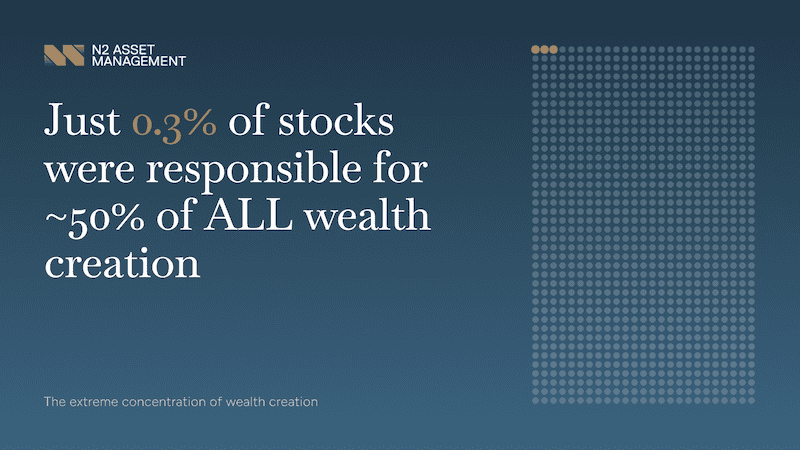
If you read just one post about investing this year, make it this one. 🚀
Because it challenges one of the most dangerous assumptions investors still hold.
The case for indexing keeps getting overwhelmingly stronger.
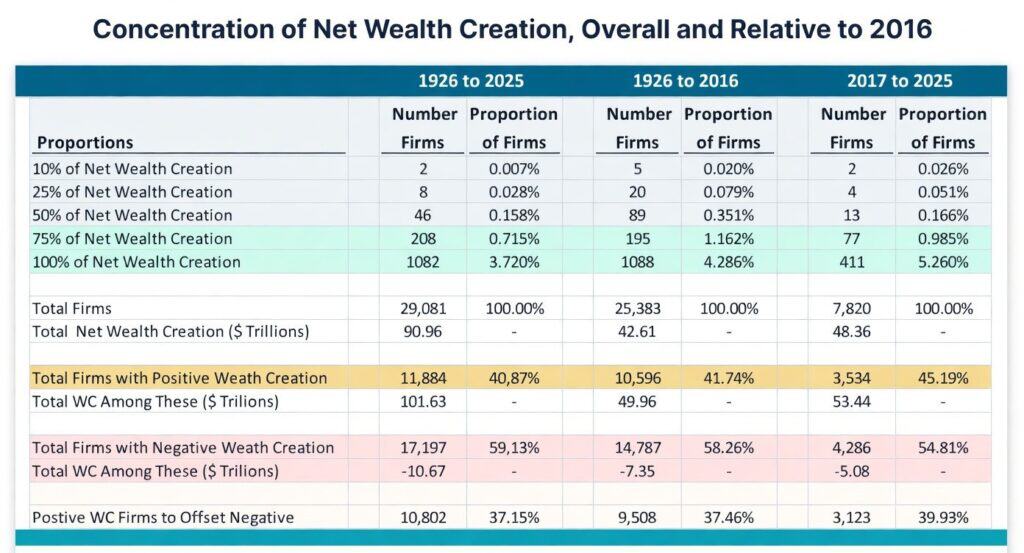
In his latest study covering a full century (1926–2025) of nearly 30,000 U.S. stocks, Hendrik Bessembinder reveals some sobering truths:
- The U.S. stock market created a staggering $91 trillion in net shareholder wealth.
- Yet just 46 companies accounted for half of that entire amount.
- The median stock delivered a lifetime return of -6.9% (Yes, it is minus❗)
- Nearly 60% of all stocks left long-term investors with less wealth than they started with.
Here are the implications that every investor should internalise:
1. Most stocks destroy value. ❌ This isn’t a temporary glitch. It’s a persistent feature of equity markets, confirmed across decades.
2. Market success is driven by a tiny handful of extreme winners. 🔥 A small right tail creates almost all the net gains. Wealth creation is extraordinarily concentrated.
3. Active stock-picking is brutally difficult. 💪 It’s not just hard to identify the winners in advance, it’s even harder to consistently avoid the many losers that erode wealth. Even if passive investors do not avoid them, they do not overweight them either.
The underlying force is positive skewness. 📊
Put simply, a small fraction of stocks, the high-flyers capable of supercharging your portfolio with outsized gains, demonstrate a pronounced positive asymmetry, with a right tail that accounts for nearly the entire aggregate market performance. The underlying force is a simple pattern: a few shares do amazingly well, while the majority quietly underperform or lose money.
This pronounced concentration and positive skewness in equity returns are precisely why the market delivers robust gains over the long term. It also illustrates why most active stock-pickers find it difficult to outperform.
Diversification is not just advice against bad luck. It is the only reliable strategy for capturing the positive tail of returns without having to predict which handful of companies those will be. Index funds are a simple way to stay diversified and avoid betting too heavily on potential losers.
The irony: the best systematic approaches do not fight this skewness; they are designed around it. Let winners run, limit losers, do not predict. The math takes care of the rest. For many long-term investors, diversification is not where conviction goes to die. It is where the probability of survival lives.
Why it matters and a quick self-check: if most of your money is in actively managed funds, you are taking the kind of risk this study warns about and you may not be able to achieve your investment objectives. If most is in broad, low-cost index funds, you are already closer to the right side of the odds.
In my next post I will explain momentum investing, arguably the only investible equity factor which is a rules-based investment process designed to hold onto rising winners and cut their losers more quickly.
Disclaimer: This article provides general information and does not constitute financial advice. Always consult a qualified financial professional before making investment decisions. Your investments will go up and down and you may receive back less than you put in.